
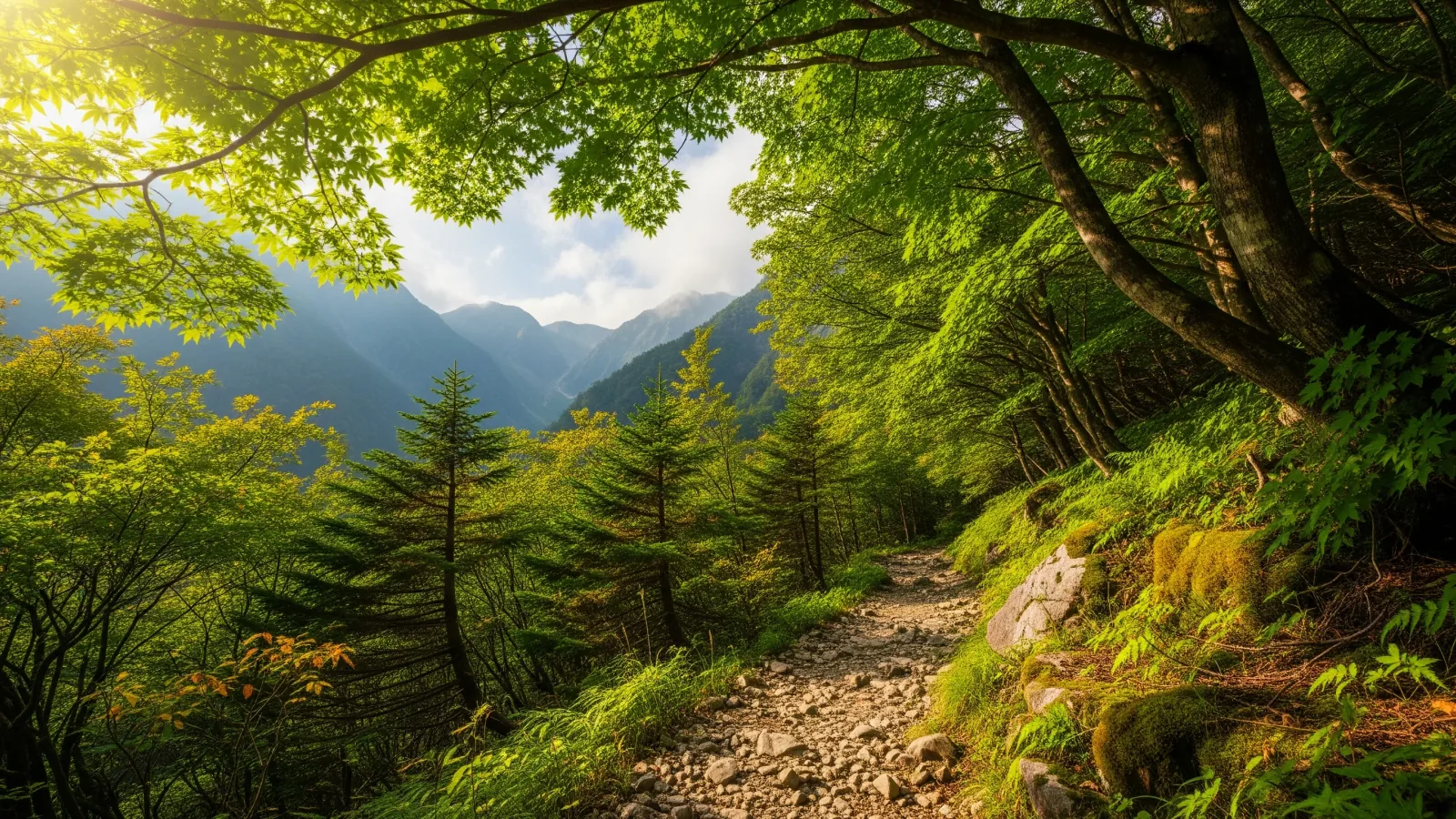
"Am I too heavy to hike?" — when you first think about getting into hiking, that question has a way of surfacing. Search around online and you'll find some people insisting you need to lose weight first, and others saying body weight matters far less than fitness, and it's genuinely hard to tell what to believe. This guide sets out, plainly, how body weight actually interacts with hiking performance — and how to think about enjoying a mountain in the body you have.
How body weight actually affects hiking — start with the physics
The essence of hiking, as an activity, is moving your own body weight up a vertical gain using your legs. Physically, the heavier you are, the more energy it takes to climb the same elevation. That part is plain fact.
But there's a part of the picture that gets overlooked. If you're heavier, your legs and your cardiovascular system have been carrying that weight every day already, and they have developed accordingly. "Heavier = can't hike" is not the equation.
What actually matters in hiking is the balance between body weight and the fitness you've built around it (strength, cardio, endurance) — not the weight number on its own. A lighter person with no exercise habit will get winded on a climb; a slightly heavier person who walks regularly will often move up the same trail in noticeable comfort.
Put concretely: a sedentary person at 55 kg and someone who walks 30 minutes a day at 75 kg, on the same mountain — it's not unusual for the heavier walker to summit more easily.
"Lose the weight, then start hiking" — a common misread
One trap beginners fall into is "I'll start hiking once I'm at my goal weight". It sounds reasonable on the surface, and it's how a lot of people manage to never actually start.
Hiking is already excellent whole-body exercise. Hours of bodyweight aerobic movement burns a lot of energy, and over time it does shift body composition. For most people, "start hiking, and your body will change as you go" is the realistic order — not the other way around.
Naturally, going straight at a mountain with more than 1,000 m of elevation gain on day one is too much load. The point is to step up gradually.
- Start with maintained hiking trails with around 300 m of elevation gain.
- Walk at your own pace; if you're getting short of breath, stop and let your breathing settle.
- Each outing, look for the feeling of "that was easier than last time" and stack those up.
Those small accumulations matter far more for your confidence than any weight number on a scale.
What "fitness for hiking" actually means
So what does "fit enough to hike" actually consist of? Broadly speaking, three things matter.
Cardiovascular endurance is the base layer for staying on the move for hours. Whether you stop getting winded on climbs lives or dies on this. A loose rule of thumb: if walking up two flights of station stairs doesn't leave you out of breath, you're in the territory where a low mountain is approachable for a beginner. (That's a general reference point; individuals and mountains vary.)
Lower-body muscular endurance matters on both the climb and — even more — the descent. The quadriceps in particular act as the brake on the way down. Weak quads mean your knees take the load directly, which is what produces the shaky-legged "knee laughter" feeling in the second half of a descent.
Balance is what carries you cleanly over uneven ground — rocks, roots, mud. If you're heavier, a loss of balance puts more impact through the joints, which is exactly why building core strength tends to pay off more, not less, at higher body weights.
None of these elements is gated by body weight. They are all things anyone, at any size, can improve with training.
Meeting your own body — how hiking changes you
There's one thing worth saying plainly here. The hiking world contains people of every body type. Some lean, some heavy-set. The important habit is to not compare yourself to anyone else.
Hiking is not a race. The same mountain, walked at your own pace, is something you can enjoy safely. Published "course times" are a rough reference, nothing more. What matters most is finding the pace at which you, specifically, can walk safely and happily. Course-time figures and what's right for you vary a lot by region and individual fitness; if you're unsure, ask experienced hikers or a mountain guide.
Six months, a year into hiking regularly, people report the same arc again and again: fitness climbs, the walking gets more efficient, and the same mountain feels like a completely different mountain. Some find the number on the scale moves; for others the scale barely shifts but body composition does, and the legs feel lighter. The shape of the change varies. The change is the constant.
What matters is taking the first step. And trusting the feeling after a hike — that quiet "that was good" — to tell you what to do next.
Summary
Body weight and hiking is not the simple "heavier = disadvantage" story. What really matters is whether you have the fitness to match your body weight, and whether you build up in steady, sensible steps.
Not "lose weight, then hike." Hike, and let your body sort itself out along the way. Hiking is one of the rare outdoor sports where that order genuinely works. Instead of fighting your body, walk a mountain with it. Repeat that conversation enough times, and the mountains tend to claim you.
If you're worrying about whether your current fitness is enough, don't sit with it alone — listen to someone who has been there. A single sentence from a hiker who once stood in exactly the same doubt can be the thing that gets you onto the trail.