
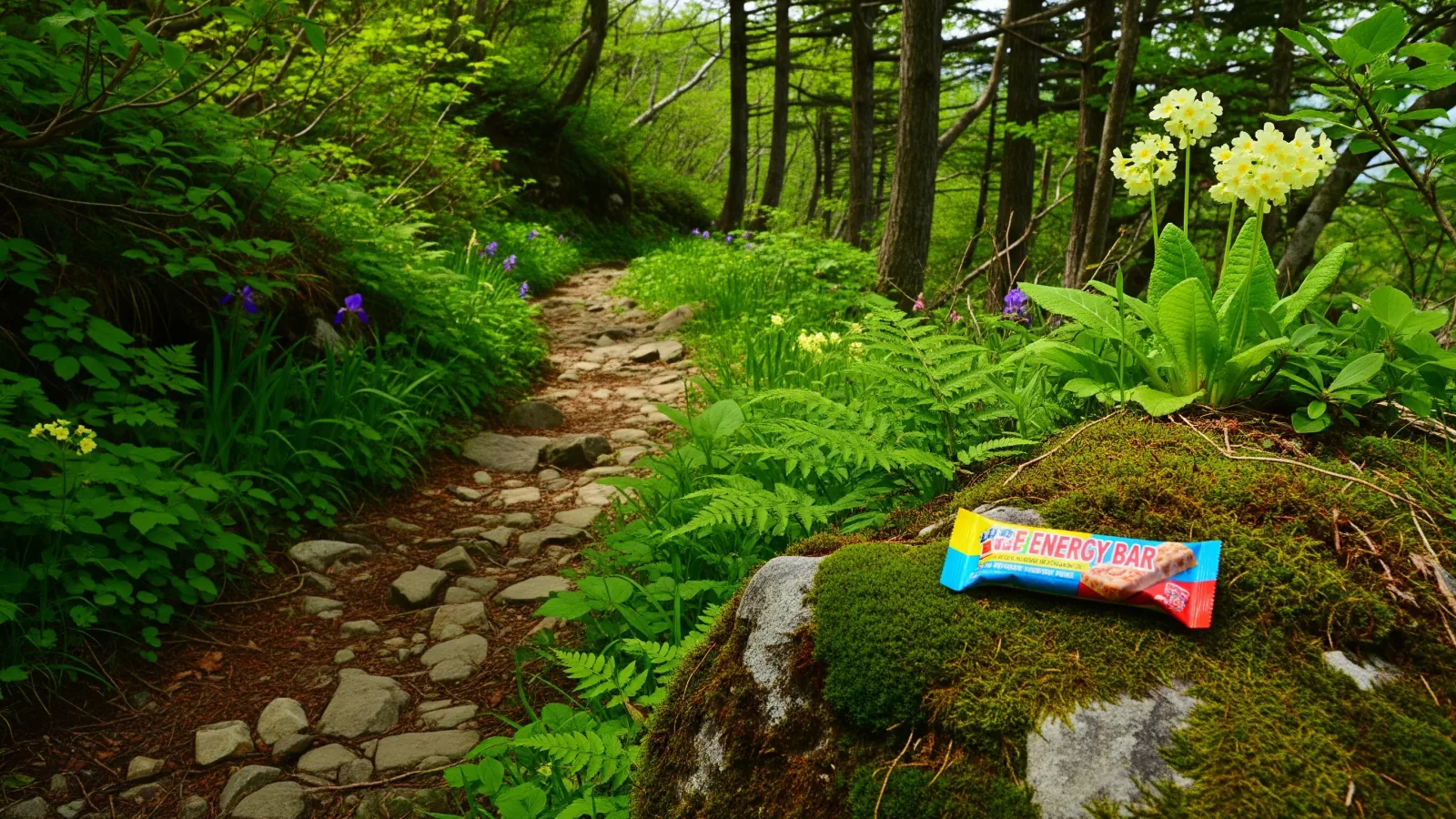
7 trail snacks every hiker should carry — compared by calories and weight
Have you ever been on a mountain when your legs simply stopped because you were too hungry to keep moving? In hiking slang it goes by several names — in Japanese it's shari-bate (bonking / hunger knock), the state where your body has run out of usable energy and you can no longer make forward progress safely. The way you prevent it is by topping up the calories that lunch alone can't cover, in small amounts, while you walk — that's the job of trail snacks. This guide picks the seven classics, scored against the trade-off that matters most: calories per gram of pack weight.
---
Why trail snacks matter — lunch alone isn't enough
Hiking burns more calories than people expect. As a general benchmark, a 60 kg person on a day hike with around 500 m of elevation gain will burn somewhere around 1,500 to 2,500 kcal (numbers vary substantially with fitness, pace, and terrain). That's roughly an entire day's worth of normal living.
There's a misconception beginners run into here: "big breakfast, big lunch at the summit, I'm fine." That alone usually isn't enough. There's a hard limit on how much energy your body can absorb and use at once, and even what you do eat takes time to turn into usable fuel. The much more effective approach is to eat small amounts every 30–60 minutes while you walk.
The dangerous thing about bonking is that by the time you feel it, you're already in trouble. The baseline rule is simple: feed yourself on schedule, before you actually feel hungry.
---
Three things to check when picking a trail snack
When you're choosing what goes in the snack bag, three properties matter.
- Calorie density (calories per gram): pack weight is a direct cost on your legs and your day. Light food with a lot of calories per gram is the goal. A reasonable target is 4 kcal per gram or more.
- Ease of eating on the move: something you can eat standing up, with one hand, in a few seconds. Anything that requires taking the pack off and assembling food isn't a trail snack.
- Heat tolerance and structural toughness: it shouldn't melt in summer heat or turn to crumbs in your pack. People who go all-in on chocolate get a hard lesson on a hot August day.
Keep those three in mind as you go through the seven.
---
The seven classics — calories and weight, compared
The numbers below are general references. Real values vary by brand and product, so always check the label.
1. Nuts (mixed nuts)
Roughly 600 kcal per 100 g (calorie density ~6 kcal/g)
The king of trail snacks. The high fat content gives a very strong calorie-to-weight ratio — a small handful packs serious energy. You also get protein and minerals as a bonus, so the nutritional profile is good across the board. The caveat is that fat takes a little longer to convert into usable energy, so it pairs best with something faster-acting from the carbohydrate side.
2. Dried fruit
Roughly 300 kcal per 100 g (calorie density ~3 kcal/g)
Mostly sugar, which means it lands faster than nuts. Mango, raisins, cranberries — the sour notes go down well even when you're tired. Mix nuts and dried fruit and you get the classic trail mix — fast and slow energy in one bag, which is exactly why it's been a standard hiker snack for as long as anyone can remember.
3. Energy bars and cereal bars
Per bar (about 40–70 g), roughly 150–250 kcal (calorie density ~4–5 kcal/g)
Individually wrapped, easy to carry, one hand, done. The split between carbs, fat, and protein varies a lot by product — read the nutrition label and pick what fits how you want the food to feel.
4. Yōkan and Japanese sweets
A small bar of yōkan (about 60 g) carries about 170 kcal (calorie density ~2.8 kcal/g)
It might sound surprising, but yōkan (a dense Japanese azuki-bean sweet) is a hugely popular hiker snack. Sugar that converts to energy quickly, doesn't melt in the heat, and travels in clean individual wrappers. New hikers often wonder why you'd take a sweet shop confection up a mountain — and then try it once and immediately get it.
5. Onigiri and bread
One onigiri (about 120 g) is around 170–200 kcal (calorie density ~1.5 kcal/g)
The most familiar trail food in Japan: the onigiri, a rice ball. Pure calorie density isn't its strength — it loses on grams per calorie — but it sits in your stomach properly and brings some salt with it, which matters. The downside is shelf life: in warm weather it goes bad quickly, so plan to eat it earlier in the day or carry it in something insulated.
6. Hard candies and tablets (salt tablets, glucose tabs)
Roughly 15–20 kcal per piece
These aren't the meal — they're the supplement. As fast-acting energy when you need a hit right now, they're invaluable. Salt candies also replace some of the sodium you've sweated out. "One more push to the top" is exactly the moment you want something you can grab from a pocket without thinking.
7. Kaki-no-tane and rice crackers
A small bag (about 30 g) is about 140 kcal (calorie density ~4.5 kcal/g)
When you can't face another sweet snack, this is the rescue. Trail food tends to skew sweet, and adding something salty into the rotation prevents flavour fatigue and also feeds you some sodium. The old hand's wisdom of carrying sweet, salty, and sour together is genuinely good engineering.
---
Build your own trail-snack mix
Seven options, sure — but the real point is to carry a mix of them. Sweet and salty. Fast-acting and slow-burning. Variety lets you respond to how you actually feel that day, not a fixed plan.
As a starting point: for a day hike, carry around 300–500 kcal in trail snacks; for an overnight with a hut stay, around 500–800 kcal is a sensible target (this varies with the route and the person — treat it as a reference).
One more thing for beginners: take food you've eaten before. Stress and fatigue at altitude can blunt your appetite for anything unfamiliar — and the new energy bar you've never tried isn't the bar you want to discover you don't like at 2,500 m. Trial-run snacks at home first.
---
Summary
Trail snacks aren't a treat — they're a piece of safety gear and a performance tool. The recap: lunch alone won't cover the calorie load of a hike. The three things to look at when choosing are calorie density, ease of eating on the move, and how the food holds up. Mix sweet with salty, eat little and often as you walk.
At first "what do I take, and how much" is genuinely hard to answer. Don't worry about it. After a few hikes your body tells you, plainly, what works for it. For now, pick two or three things from the list above that look interesting, and try them on your next outing.