
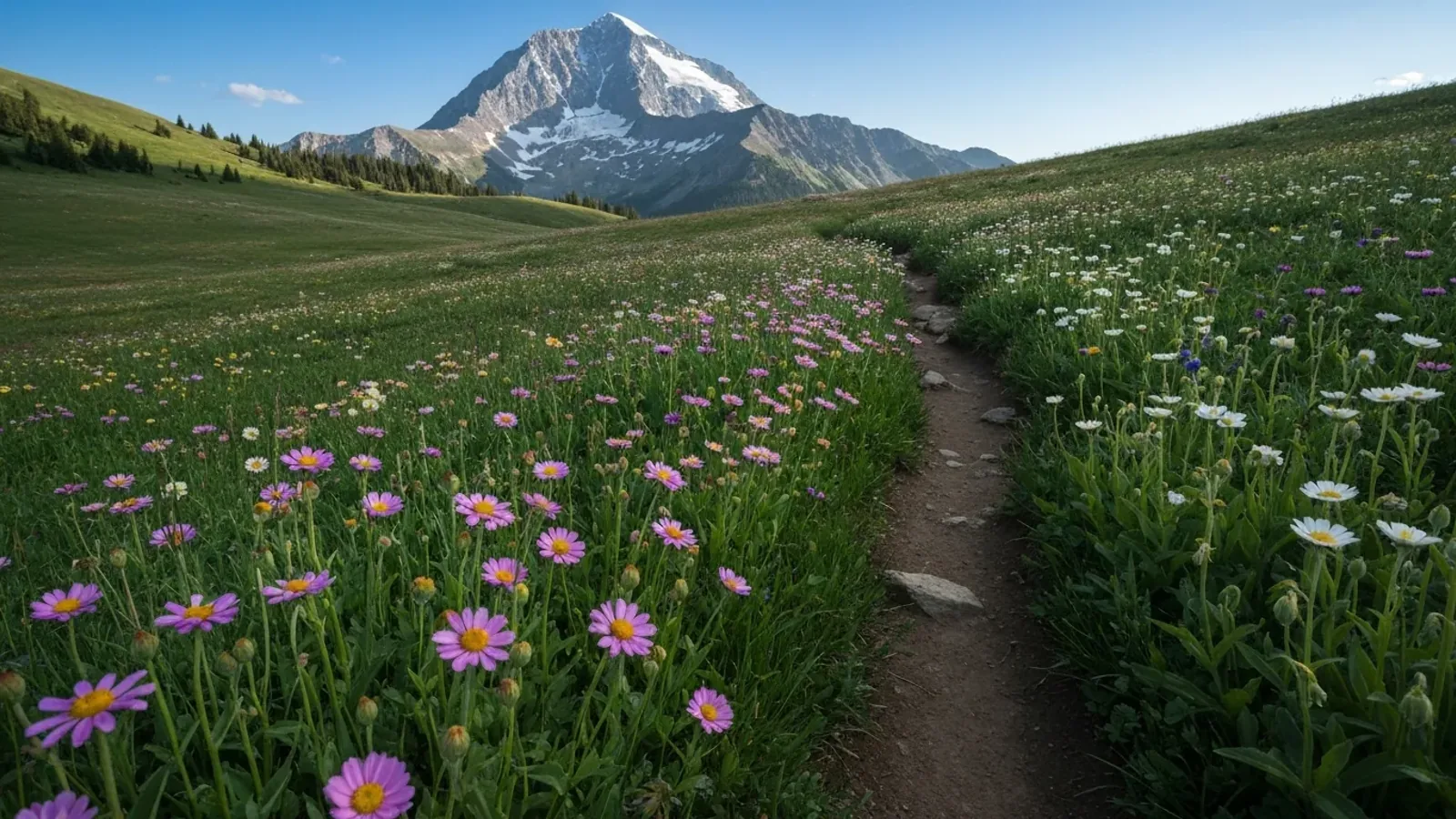
Narrow trail, someone coming the other way. Which side do you step to? And actually — who goes first, uphill or downhill? Most hikers know "uphill has priority," but explaining the reasoning is rarer than it should be, and the rule has several important exceptions worth knowing. This guide digs into the why of passing etiquette, so you can act without hesitation on the trail.
The bottom line — uphill or downhill, who goes first?
Short answer: on the trail, the convention is that uphill hikers have right-of-way. The person heading down steps aside — onto the uphill side of the path — and lets the climber come through. Three reasons sit behind it: it keeps the climber's breathing rhythm from breaking, the descending hiker usually has the clearer view ahead, and it keeps a dislodged rock or a slip from above off whoever's below. The exception: on ladders, chained sections, or anywhere there's no safe spot to wait, the downhill hiker goes first. Get the basics down, then we'll dig into the reasons and the exceptions.
The three reasons "uphill has priority"
"Uphill hikers have right-of-way" appears in just about every beginner hiking guide. So why? The convention rests on three concrete safety and physiology reasons.
First — to protect the climber's rhythm. Going uphill, your heart rate is higher and the energy cost per step is much greater than going down. The breathing rhythm you've finally settled into is hard-won, and breaking it to stop for a passing hiker means extra fatigue when you start again. Picture climbing a steep section one breath per step — the difference between being asked to stop and being waved through is enormous on the legs.
Second — visibility. A climber's eyes are usually fixed on the next foot placement and the slope just ahead, so they notice someone coming down from above relatively late. The descending hiker has a much wider view of the trail and tends to see the climber first. Whoever sees first finds the safe spot to wait — that's the logic.
Third — falls and rockfall. Descending is more likely to cause slips and to kick small stones loose than climbing. A descending hiker forced to pass on unstable footing risks either falling onto the climber below, or sending rocks down onto them. Letting the climber clear the section first removes both of those risks.
The detail most hikers don't know — step to the uphill side
When you yield, the other thing that matters is which side you step to. The person stepping aside should move to the uphill side (the slope above the trail) and wait.
"Isn't there more space on the downhill side?" — that's the intuitive guess, and it's wrong. If you wait on the downhill side and the passing hiker loses balance, you get clipped into the drop. The trail edge can also collapse under you in places where the shoulder is soft. Standing on the uphill side, the worst-case collision is two hikers pressed into the slope — much safer for both of you.
This "step to the uphill side" detail is arguably more important for actual safety than the uphill-priority rule itself. Keep it.
When the uphill-priority rule doesn't apply
This is the part most worth carrying off the page. "Uphill priority" is one default, not an absolute rule. The principle underneath it is "safety first", and that's the thing to defer to.
Situations where the default should bend:
- Ladders and chain sections — descender has priority: ladders and fixed-chain sections only fit one person at a time and don't have a safe place to pause halfway through. Whoever is already on the section finishes it. Descending is also technically harder and slower, so the convention is to let descenders clear first.
- When the descender has nowhere safe to stop: on a narrow stretch with no stable place to stand, the descender shouldn't force a stop. "My footing is narrow, I'll come down first" — say it, get to a safe spot, and let the climber resume.
- Long line of climbers: if uphill hikers keep coming in a continuous queue, the descender ends up immobile forever. In practice, both sides talk to each other and alternate at sensible breaks.
- Climber actually wants a rest: if you're climbing and you're cooked, just say "go ahead, please" and take the break that yielding gives you. The rule does not require you to suffer.
In other words: "uphill priority" is the default frame, not an absolute law. Terrain, weather, the fitness of both parties, whether there's anywhere to wait — read the situation and pick what's actually safest in that moment.
The thing that actually makes passing work — a short word
More than the priority rule, the thing that actually makes trail passes work is talking.
"Hi." "Go ahead." "Thanks." — short sentences, but they communicate intent and the rest of the pass becomes smooth. Two hikers approaching each other in silence is, oddly, much more stressful for both of them.
Especially as a beginner, you'll find yourself wondering whether to wait or to push through. That's exactly when to speak: "How do you want to do this?" "Want to go first?" The other person is usually equally uncertain, and the simple act of asking unblocks the situation.
There's another, quieter dimension to greetings on the mountain. They're not just etiquette — they're a safety check that says "I've seen you." In the rare case of a search-and-rescue, the memory of the last hiker someone passed becomes part of the trail of evidence.
Summary
Passing etiquette on a trail does not collapse down to "uphill has priority." Behind that rule sit three real reasons — rhythm preservation, the visibility differential, and rockfall risk — and at the same time, there are real exceptions: ladders, chain sections, and any spot where the descender has nowhere safe to wait. The principle behind all of it is the same: safety first.
And what actually makes safety work isn't memorising the rules — it's reading the moment and saying something. Step to the uphill side, speak, don't force the rule when it doesn't fit — get those three habits going and trail passes stop being a source of awkwardness. Try it on your next hike.