
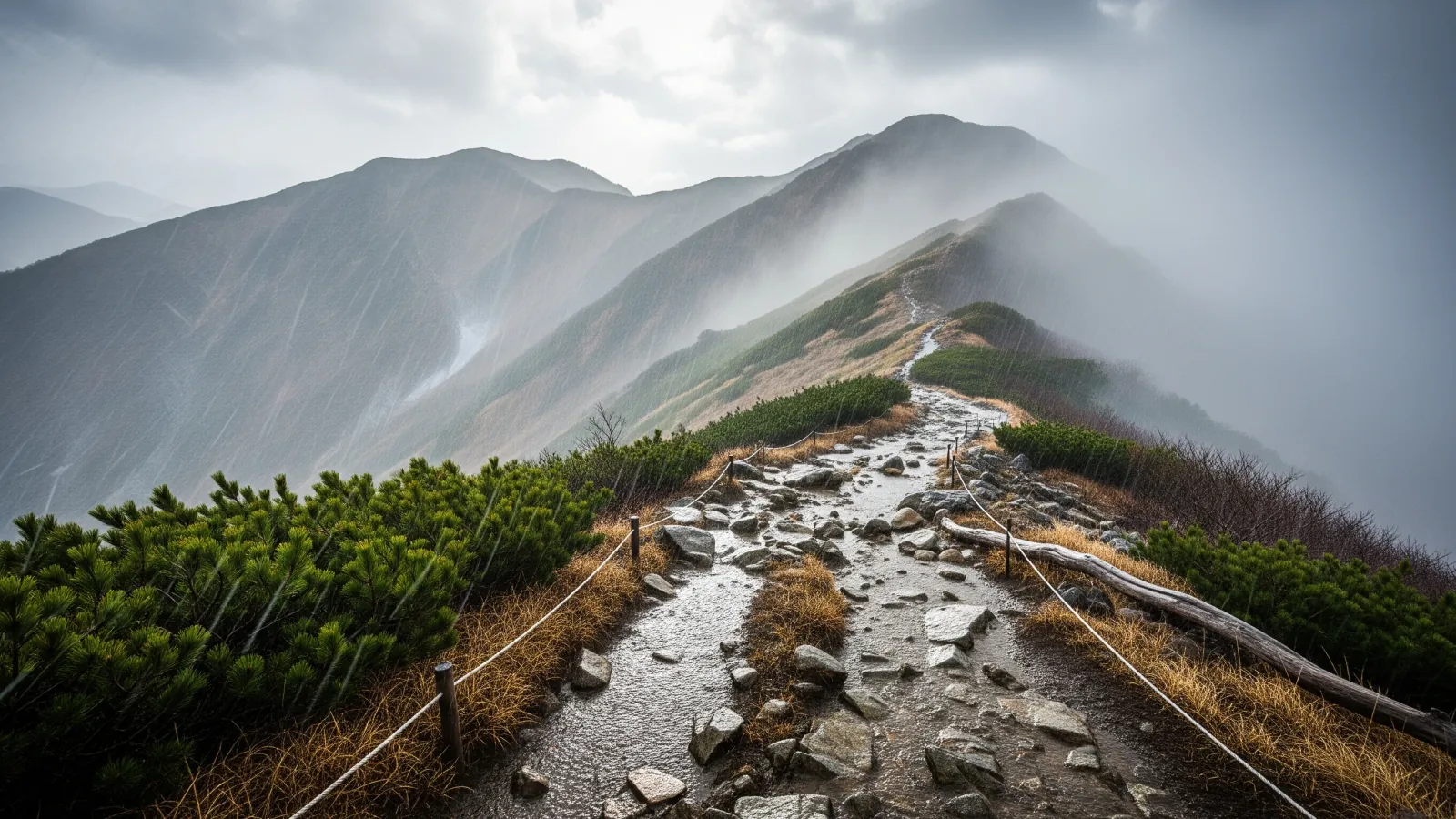
"Rain gear is rain gear — they all just keep the rain off, right?" If that's where you are, you should know that rain in the mountains is a different animal from rain in town. Weather changes fast at altitude, and sideways rain on a windy ridge will strip body heat out of you fast. This piece explains why Gore-Tex became the default fabric for serious hiking shells, written so a beginner can understand the mechanism — and once you understand the material, you have a real basis for picking the jacket that fits you.
"Waterproof" and "breathable" — the two functions a rain shell has to deliver
Hiking rain gear has to do more than block rain. That is the deciding line between a hiking shell and the cheap vinyl rain poncho you'd buy at a convenience store in town.
Climbing makes you sweat heavily. If that sweat vapour gets trapped inside the jacket, you end up dry on the outside and soaked on the inside — which entirely defeats the point. Wet clothing pulls heat out of the body fast, and that is how hypothermia happens even on summer mountains.
So a hiking rain shell needs both of these properties at once:
- Hydrostatic head (water column): resistance to water (rain, snow) pushing in from the outside. For hiking, a common target is 20,000 mm or above.
- Moisture vapour transmission rate (breathability): ability to let internal water vapour escape. A reference target is 10,000 g/m²/24h or higher — at that point the stuffy, clammy feeling on the move is noticeably reduced.
Note: these numbers vary with test conditions and field use. Treat them as general references, not strict thresholds.
Beginners often get stuck on "higher water resistance = better." That's not the right read. If a fabric blocks water perfectly but traps vapour, the inside is still wet — defeating the whole purpose. The actual key is the balance between waterproofness and breathability, and that's the centre of picking a hiking shell.
How Gore-Tex actually works — why water stays out and vapour gets through
Gore-Tex is, at its heart, an extremely thin membrane made of ePTFE (expanded polytetrafluoroethylene). That membrane is perforated with microscopic pores — around 1.4 billion of them per square centimetre.
Here's the trick. Water droplets are physically much larger than water-vapour molecules. The pores in Gore-Tex are sized exactly so that vapour molecules can pass through, but droplets cannot.
An easy way to picture it: think of a window screen. Wind (vapour) passes through; raindrops (water droplets) get caught by the mesh and don't make it inside. Gore-Tex applies the same principle at a nanometric scale of precision.
Bare membrane on its own is too thin to handle. Real products sandwich the membrane between an outer face fabric and a lining — the laminate construction. When you see "2-layer" or "3-layer (3L)" on a hiking jacket, that's referring to this construction. In broad terms, 3L feels more integrated and is more durable; 2L tends to come out lighter.
Where Gore-Tex differs from other waterproof-breathable fabrics
Gore-Tex isn't the only waterproof-breathable fabric. Several manufacturers have developed their own. Some examples:
- Polyurethane (PU) coatings: a polyurethane film applied to the back of the face fabric. Cheaper to make waterproof, but breathability often doesn't reach Gore-Tex's level, and they tend to degrade over time (hydrolysis).
- Other manufacturer-specific membrane fabrics: membrane-based like Gore-Tex but pursuing the performance from a different angle. Some lean further into breathability, others into low weight. They each have strengths.
Why Gore-Tex became the standard isn't just performance. It's also decades of track record and reliability, combined with strict quality control. To carry the Gore-Tex label, a finished garment has to pass the material maker's own product-level testing on top of the membrane spec — which means quality assurance covers seam taping, zip construction, and the whole product, not just the fabric.
That said, Gore-Tex is not the only right answer. The best choice depends on your hiking style, frequency, and budget. The point is to understand the material so you can choose what fits you.
How to make it last
Even the best fabric's life depends on how you use and care for it. If your rain shell's water beading starts to fade, washing it and then putting it through a low-heat tumble dry — or applying low heat with an iron — can revive the surface DWR coating. The mechanism is that heat realigns the water-repellent groups on the fabric surface.
And after a hike, clean the dirt off promptly and let it dry properly. Sweat, skin oils, and mud left on the fabric clog the microscopic pores of the membrane and degrade breathability over time.
Note: for specific washing and care procedures, follow the care instructions that came with your product.
Summary
Rain gear is one of the "three essentials" of hiking. The reason Gore-Tex has been the default for decades is that it carries waterproofness and breathability together at a high level, and the brand applies strict quality control across the whole product.
Three things to remember. Waterproof-vs-breathable balance is the centre of the decision; Gore-Tex's mechanism is physical size discrimination through microscopic pores; and regular care is what keeps the performance alive.
Once you understand how the material works, reading the spec sheet in a store or online becomes a genuine skill, not a guessing game. Use this background the next time you're picking a rain shell to fit the way you actually hike.