
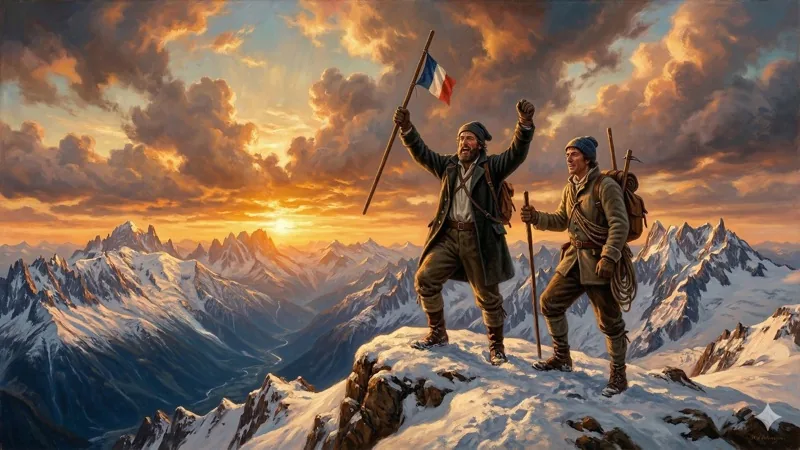
8 August 1786. In the town of Chamonix in eastern France, people were peering through telescopes. On the summit of Mont Blanc (4,808 m), the highest peak in the Alps, two small figures had just appeared. A crystal hunter named Jacques Balmat, and a doctor named Michel-Gabriel Paccard. Their climb is what historians usually call the birth of modern alpinism.
Behind that historic moment, though, sat a quieter drama: a long-running cash prize, and an even longer argument about which of the two men actually deserved the credit. This is the story of how Mont Blanc was first climbed.
It all started with Saussure's prize money
The story actually begins 26 years earlier. In 1760, the Geneva naturalist Horace-Bénédict de Saussure, then just 20 years old, came to Chamonix on a botany trip. He was so taken with Mont Blanc that he announced a cash reward for the first person to find a viable route to the summit.
At the time, Mont Blanc was feared. The high peaks were thought to be places of death, and just getting close to a summit was widely considered foolhardy. Saussure himself wanted to make scientific observations from the top, but every attempt — including his own — had failed.
From the day the prize was announced, 26 years went by without anyone setting foot on the summit of Mont Blanc.
Balmat and Paccard — how they met
The crystal hunter — Jacques Balmat
Jacques Balmat (1762–1834) was a hunter and crystal collector born in the Chamonix valley. His whole life was earned from the mountains, and by all accounts he had been dreaming about being the one who finally reached the summit of Mont Blanc — and the cash prize that came with it.
In June 1786, Balmat joined an attempt on Mont Blanc but the whole party was forced down by bad weather. In the descent he became separated from the others and ended up bivouacking alone on the glacier. A brutal night — but a night that gave him something no one else had: the confirmation that you could survive overnight at altitude on this mountain.
The doctor — Michel-Gabriel Paccard
Michel-Gabriel Paccard (1757–1827) was a doctor born in Chamonix who had studied medicine in Turin. A physician by profession, but with a serious sideline in mountain research — he had been up to reconnoitre Mont Blanc many times over the years.
Paccard had concluded that the conventional lines other climbers had been trying simply did not go through. He had spent years watching Mont Blanc through a telescope, recording the way the glaciers moved and where the avalanches ran. His plan was a new route by way of the snow basin — what he called the "snow valley."
Why the two of them teamed up
After his solo bivouac on the glacier, Balmat went straight to Paccard. Paccard was fascinated by the fact that someone had survived a night that high. He proposed Balmat join him on the new route he had been studying. Paccard's careful planning, Balmat's hard-won physical experience of the mountain — the combination was the climb. The two of them agreed to go for the summit together.
8 August 1786 — the route to the summit
On the afternoon of 7 August 1786, Paccard and Balmat left Chamonix. Their loads contained blankets, food, and Paccard's scientific instruments — but no rope and no ice axe. The only tools they carried were two long wooden poles, roughly three metres each.
They spent the night sheltered under a rock on the Montagne de la Côte, and set off again at first light on 8 August. The notorious section called the Jonction — a chaos of broken glacier — took them roughly five hours, using their poles to bridge crevasses and step across collapsing seracs.
Eleven hours in, they reached the Grand Plateau, with about another 900 m of climbing left to the summit. The wind was howling, and they kept going anyway.
Down in Chamonix, crowds had gathered with telescopes and field glasses to watch them go. At 6:23 p.m. — some accounts say 6:32 — the two of them stood on the summit of Mont Blanc. When the news reached the town, the church bells were rung. On the summit, Paccard made scientific observations — temperature and air pressure — before they started down.
On the descent, Paccard was suffering badly from snow-blindness and frostbite, and Balmat — by every account — guided him down.
The fight over who actually summited — and Paccard's restored name
After the descent, Balmat went to Saussure and collected the prize money. King Victor Amadeus III of Sardinia later granted Balmat the honorary title "dit Mont Blanc" — "the man of Mont Blanc".
And then, about a month after the climb, an ugly rumour started to circulate. That Paccard had collapsed from exhaustion partway up, and Balmat had gone on to the summit alone. The source of the story was a Swiss alpine traveller named Marc-Théodore Bourrit, who had himself tried for Mont Blanc, failed, and is widely thought to have set out to diminish Paccard's role deliberately.
In 1832, five years after Paccard's death, the novelist Alexandre Dumas interviewed Balmat and published a version of the story in which Paccard had repeatedly said he could go no further and had to be hauled up by Balmat. Dumas was widely read, and his version of the climb stuck. For decades after, Balmat was the only one of the two remembered as the hero.
The truth gets dug up
In the years that followed, a journal and sketches turned up from a German scientist named Gersdorff, who had watched the climb that day through a telescope — and his account flatly contradicted Dumas. Then, 143 years after the first ascent, Paccard's own written account of the climb was discovered and published in a British climbing journal. In his own words: "we reached the summit essentially together".
In 1986, at the 200th-anniversary celebrations of the first ascent, France formally restored Paccard's name. The existing statue in Chamonix — Balmat standing beside Saussure — was joined by a separate monument to Paccard alone. Today both men are recognised, properly, as the climbers who made the first ascent of Mont Blanc.
What the first ascent of Mont Blanc left behind
The 1786 climb wasn't simply one mountain getting its first ascent. It opened the gate. Adventurers and explorers began arriving in the Alps in serious numbers, and professional guide associations and the first mountain-guide schools followed in their wake.
The very next year, in 1787, Saussure himself climbed Mont Blanc, guided by Balmat and accompanied by 18 porters. He spent two days on the summit making scientific observations. That second ascent is usually positioned as the birth of "sport climbing" — climbing as a pursuit in its own right.
From there, climbers' eyes turned to the unclimbed peaks of the Alps, and eventually to the Himalaya. In 1865, Edward Whymper made the first ascent of the Matterhorn, and the history of climbing turned another page.
The British climber Eric Shipton later wrote of the Mont Blanc first ascent that the two of them had not merely walked into unknown country — they had climbed a route that every guide of their time had considered impossible. Balmat and Paccard's climb is, in that sense, the proof that a peak everyone said couldn't be climbed could be climbed. The starting point of the whole history of alpinism.
Today, around 20,000 people climb Mont Blanc every year. The line two men cut up the mountain 238 years ago is now one of the most-walked summits in the world.