
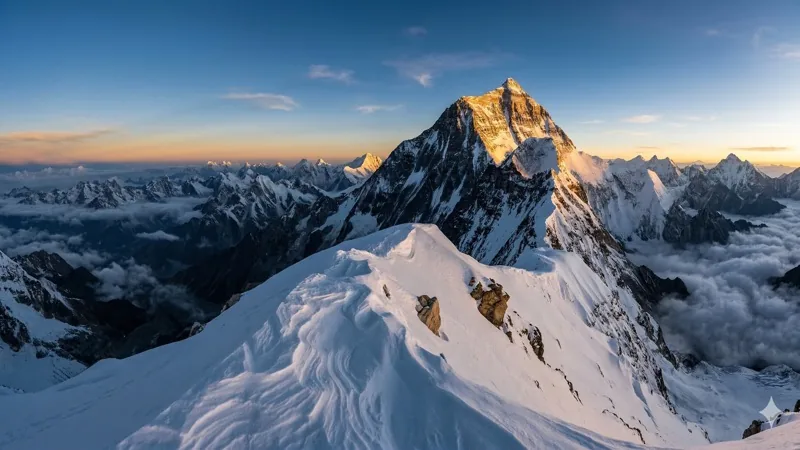
Who Junko Tabei was — from a small Fukushima town to the highest summit on Earth
Junko Tabei was born on 22 September 1939 in Miharu, a small town in Fukushima Prefecture, the youngest of ten siblings. She fell for the mountains in fourth grade, on a school trip to Mt. Chausu in the Nasu range — the moment she understood that walking on her own two feet could open up a much bigger world.
At Shōwa Women's University in Tokyo, where she studied English literature, she joined the climbing club and began climbing seriously. After graduating she kept at it through working-adult alpine clubs, taking on the rock faces of the Tanigawa and Hotaka ranges. Japanese climbing in that era was an almost entirely male world, and the assumption that women didn't belong on certain mountains was something Tabei said quietly bothered her for years.
Founding the Joshi-Tohan Club and the push for an overseas expedition
In 1969, wanting "to climb mountains overseas with an all-women team," Tabei founded the Joshi-Tohan Club (Ladies Climbing Club). At the time, the idea of an all-female expedition aiming at a major foreign peak was unusual enough that the team faced no shortage of skepticism.
In 1970, the club went to the Nepal Himalaya and successfully climbed Annapurna III (7,555 m) — the first time a Japanese woman had stood on top of a 7,000 m peak in the Himalaya. That success was the door that opened onto the next goal: Everest.
In 1971, Tabei filed the expedition's application with the Nepalese government. Permission came through in 1972, with the climbing window set for spring 1975. The total budget came out around ¥43 million, and fundraising was brutal. Corporate sponsors were hard to find, and the team scraped the money together by teaching English classes from their homes and living lean for years.
The 1975 Everest expedition — surviving the avalanche
In spring 1975, the Japanese Women's Everest Expedition (team leader Eiko Hisano, deputy leader and climbing leader Junko Tabei) attacked Everest from the Southeast Ridge route on the Nepalese side — 15 climbers plus Sherpa support.
Before dawn on 4 May, an avalanche tore into Camp 2 at around 6,300 m. Tabei was buried inside her tent and briefly lost consciousness; a Sherpa dragged her out, and she came back. Every member of the team came away with full-body bruising. It was a serious accident, the kind that ends an expedition.
Most leaders would have turned around. Tabei argued for continuing. Aching head to toe, the team kept acclimatising and ferrying loads to the upper camps. Then six Sherpas went down with altitude sickness, oxygen resupply ran into trouble, and the difficulties kept coming, one after another.
Summit day — 16 May 1975
At 12:35 p.m. on 16 May 1975, Junko Tabei, climbing with the Sherpa Ang Tshering, became the first woman in the world to stand on the summit of Everest (8,849 m). She was 35 years old.
The view from the summit was a full 360-degree panorama. Tabei later said the first thing she felt up there wasn't a wave of triumph — it was the climber's instinct that she needed to get down, fast. Time spent above 8,000 m has a way of compounding into risk, and a working summit-day brain runs on cold arithmetic.
The climb made global news and turned Tabei, almost overnight, into a household name. Just eleven days later, on 27 May, Phantog of China climbed Everest from the Tibetan side, becoming the second woman to reach the summit. 1975 turned out to be a watershed year for women in high-altitude climbing.
The Seven Summits and a life of mountain advocacy
After Everest, Tabei didn't stop. She worked her way through the highest peaks of each continent, and in 1992, with Mt. Elbrus (the highest mountain in Europe), she became the first woman in the world to complete the Seven Summits.
- 1975 — Everest (Asia, 8,849 m)
- 1980 — Kilimanjaro (Africa, 5,895 m)
- 1987 — Aconcagua (South America, 6,961 m)
- 1988 — Denali (North America, 6,190 m)
- 1988 — Vinson Massif (Antarctica, 4,892 m)
- 1991 — Carstensz Pyramid (Oceania, 4,884 m)
- 1992 — Elbrus (Europe, 5,642 m)
Alongside the climbing, Tabei poured energy into the work of getting more people up mountains responsibly. As president of HAT-J (Himalayan Adventure Trust of Japan), she ran clean-up expeditions year after year, hauling abandoned rubbish off the slopes around Everest. She also went back to school — completing a master's degree at Kyushu University's graduate school on environmental problems on Everest.
Tabei was deliberate about climbing with people of all ages and experience levels. She organised entry-level hiking tours, and her public talks about the simple joy of being on a mountain are still the part many of her followers remember most clearly.
Climbing through illness — and what she left the next generation
In 2007, Tabei was diagnosed with breast cancer. She kept climbing through treatment. In 2012 she was diagnosed with peritoneal cancer; in 2014, a brain tumour. She still did not stop climbing.
The project that took the most of her in those final years was taking high-school students from the 2011 Tōhoku earthquake area up Mt. Fuji. The idea — "I want kids who lost so much in the disaster to feel what it's like to climb the highest mountain in Japan on their own feet" — became an annual programme that ran every year through her illness.
On 27 July 2016, despite her advanced illness, she climbed Fuji with the Tōhoku students one more time. It was her last climb. She died on 20 October the same year of peritoneal cancer, at 77. To the end, her life was about the mountains and about staying connected to people through them.
In 2019, the International Astronomical Union named a mountain range on Pluto Tabei Montes. The first woman to stand on top of Earth now has her name etched into another world entirely.
Summary
Junko Tabei's life is the record of someone who simply kept walking past the wall of "because you're a woman." Her 1975 summit was a turning point in women's climbing history, and her Seven Summits opened a road that the women who came after her have been walking ever since.
What she most wanted to leave behind, though, probably wasn't the records. It was the joy of being on a mountain. Beginner tours, Fuji climbs with high-schoolers from the disaster region, decades of cleanup work — each of those was a bridge between the mountain and a particular person. Mountains aren't reserved for a special few. Anyone can stand in front of one, at their own pace, on their own feet. Tabei's life says that quietly, and unmistakably.