
Who Naomi Uemura was — from a Hyōgo farm to the world's last frontiers
Naomi Uemura was born on 12 February 1941 in Kokufu village in the Kinosaki district of Hyōgo Prefecture (now part of the city of Toyooka), the youngest of seven children in a farming family. As a boy he was, by his own account, unremarkable. The pivot in his life came when he entered Meiji University and joined the alpine club.
At first he had no endurance for it. He struggled just to keep up with the senior members. But the pull of the mountains grew quickly, and by his third year he was spending around 130 days a year in the mountains — that is when the patience and solo capability that would later define his expeditions began to form.
In 1964, after graduating, Uemura sailed for the United States on an immigrant ship with a one-way ticket. He worked his way across America, then on to France, taking odd jobs to fund what came next. The wandering lasted four years and five months, and during those years he climbed Mont Blanc (1966), Kilimanjaro (1966), and Aconcagua (1968), one continent's highest peak after another.
Highest summits on five continents — from Everest to Denali
The climb that put Uemura's name in front of the world was the Everest summit of 11 May 1970. As part of a Japanese Alpine Club expedition, he became the first Japanese climber to stand on the summit of Everest. He was 29.
Just three months later, in August of the same year, Uemura made the solo summit of Mt. McKinley (now Denali, 6,190 m), the highest peak in North America. That climb made him the first person in the world to summit the highest mountain on each of five continents.
- 1966 — Mont Blanc (Europe, 4,807 m)
- 1966 — Kilimanjaro (Africa, 5,895 m)
- 1968 — Aconcagua (South America, 6,961 m)
- 1970 — Everest (Asia, 8,849 m)
- 1970 — Denali (North America, 6,190 m)
What's striking is that — apart from Everest — Uemura climbed every one of these solo. In an era when expedition-style climbing was the standard, he chose, deliberately, to face mountains alone. It may have been the result of a question he kept asking himself: what is adventure, really?
The polar years — dog sleds and the North Pole
With the five highest summits behind him, Uemura turned to a new arena — the poles. From summit to ice cap can look like an abrupt jump, but for Uemura it was a continuation of one idea: stepping into the unknown with only what he carried on his body.
From 1972 into 1973, he lived in Siorapaluk — the northernmost village in Greenland — with the Inuit. Dog-sled driving, how to live through deep cold, hunting on the ice — he learned all of it directly from the people who already knew. That habit of "belonging where you go" runs straight through every expedition he undertook.
Between 1974 and 1976 he travelled 12,000 km across the Arctic alone by dog sled. Then, in 1978, he became the first person in the world to reach the North Pole by solo dog sled. Through weeks below −50 °C, on the ice with his dogs, that journey may have been the hardest of all the expeditions of his career.
Winter Denali — the last climb
After the North Pole, Uemura set his sights on a new goal — a solo dog-sled traverse of Antarctica. In 1982, the Falklands War cut off the Argentine military support he needed, and the project had to be shelved.
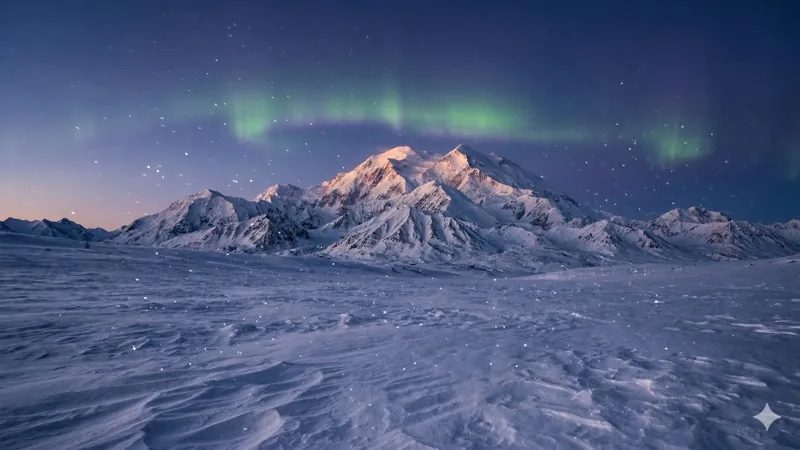
In January 1984, partly as preparation for another Antarctic attempt, he set out to make a solo ascent of Denali in deep winter. Winter on Denali means temperatures below −40 °C and savage winds — about as brutal an environment as the mountain produces. No one had ever made a solo winter ascent of it.
He flew onto the Kahiltna Glacier on 26 January and started up from Base Camp on 1 February. On 12 February 1984 — his 43rd birthday — Uemura became the first person to make a solo winter ascent of Denali.
And then, after a final radio contact on 13 February, all contact with him broke off. In that last transmission he confirmed the summit and reported his position. It was the last anyone heard from him. A large-scale search was mounted. A snow cave on the mountain was found with his diary and camera inside. Uemura himself was never recovered.
The last page of the diary the search team found is said to have read: "No matter what, I'll climb McKinley."
What Uemura left behind
When the news of Uemura's disappearance broke, donations poured in from across Japan to help fund the search. That April, with him still missing, he was posthumously awarded the People's Honour Award (Kokumin Eiyo-shō).
Sir Edmund Hillary, first to climb Everest, called Uemura "the greatest adventurer." The Himalayan Mountaineering Institute in India hung his portrait on its wall as "the greatest climber of the 20th century."
To carry the spirit of his work forward, his home town of Toyooka built the Naomi Uemura Memorial Museum of Adventure. In 1996, the Naomi Uemura Adventure Award was established to recognise extraordinary adventurous achievement, and it has been given out annually ever since.
What still draws people to Uemura, decades on, is not just the size of the records. It is the way he travelled: respectful of the cultures he passed through, quiet in the face of the natural world. That posture — beyond the category of "adventurer" — is what continues to resonate.
Summary
Naomi Uemura's career is decorated with firsts: the highest peaks of five continents, mostly solo; the first solo dog-sled crossing to the North Pole; the first solo winter ascent of Denali. Records, yes — but the more honest reading of his work is that what he was really chasing wasn't the records. It was a long, continuous conversation with the unknown, and with himself inside it.
More than 40 years after he disappeared in 1984, Uemura's body has never been found. He is still up there, somewhere in the winter snow on Denali. The path he walked, though — alone, on his own feet, into territory no one had been into before — has not faded for anyone who loves climbing or adventure. It is still the line a lot of us are quietly trying to follow.