
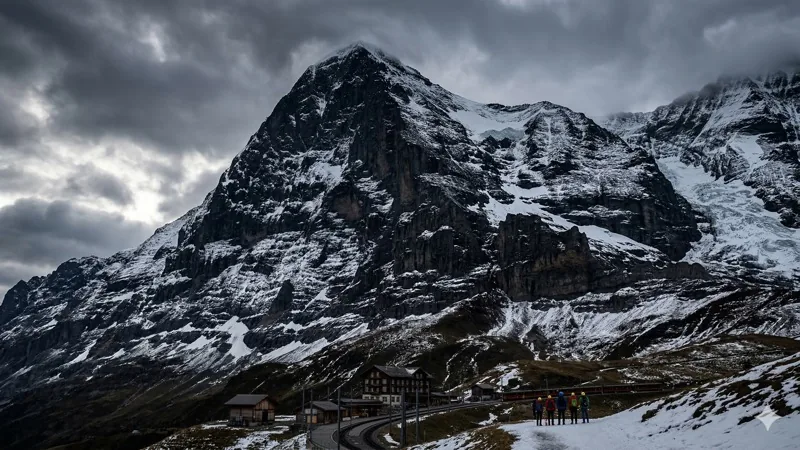
What the Eiger North Face is
The Eiger (3,970 m) rises out of the Bernese Alps in Switzerland. With the Jungfrau and the Mönch, it forms the famous trio of Bernese summits — and on its north side, the mountain drops away in a single immense rock face roughly 1,800 m high. This is the Eigernordwand: the north face of the Eiger.
Together with the north faces of the Matterhorn and the Grandes Jorasses, it is counted as one of the three great north faces of the Alps. In German, climbers gave it a darker name — playing on the spelling of Nordwand ("north face") to call it Mordwand ("murder wall"). Built largely of fragile limestone, the face is famous for rockfall and for sudden, total changes in the weather. In the 1930s, the contest to make the first ascent of this wall produced one of the most harrowing stories in the history of alpinism.
The first attempts, the first dead — 1934–1935
1934 — the first victims
The first serious attempt on the Eiger north face on record came in 1934. The Germans W. Beck and G. Löwinger started up the wall, fell at around 2,900 m, and died. They were the first climbers killed on the Eiger's north face.
1935 — the "death bivouac"
In August of the following year, the Munich climbers Max Sedlmayer and Karl Mehringer attacked the face. They picked a direct line; by the second day they had reached the Second Icefield, and there the storm hit.
Down in the village of Grindelwald, people watched the two of them clinging to the wall through telescopes. The storm went on for three days. After the third day, the two figures stopped moving. About a month later, a flight over the face spotted one of the bodies near the Third Icefield. That spot has been known ever since as the Todesbiwak — the "death bivouac".
Climbers dying on the face while villagers below watched through telescopes — that detail, more than anything else, gave the Eiger its peculiar atmosphere of grandeur and dread.
1936 — the death of four young climbers
The Nazi shadow and the Olympics
1936 was the year of the Berlin Olympics. The Nazi regime had decided that alpinism was a useful instrument of national prestige, and there was even talk that the first team to climb the Eiger north face would be awarded an Olympic gold medal. It is widely accepted that this political pressure was part of what pushed so many young climbers onto the wall that summer.
Four challengers
In July 1936, two pairs began up the face. From Germany, Andreas Hinterstoisser and Toni Kurz. From Austria, Edi Rainer and Willy Angerer. All four were in their twenties — gifted, strong, and ambitious.
The two pairs met on the wall and joined forces. Hinterstoisser solved the smooth, near-vertical slab below the First Icefield with an audacious pendulum-traverse on a fixed rope — a piece of technique that would go down in climbing history as the Hinterstoisser Traverse.
Retreat — and despair
When Angerer was hit by rockfall, the four of them decided to descend. That was when the fatal mistake revealed itself: they had pulled the traverse rope down after themselves on the way up. Reversing the traverse over the now ice-glazed slab without a fixed line was simply not possible.
The four chose another descent line, rappelling repeatedly toward the gallery window of the Jungfrau railway tunnel (the Eigerwand station opening) cut into the face. On 21 July, an avalanche caught them mid-rappel. Hinterstoisser, who happened to be unclipped, was thrown down the wall. Angerer was slammed into the rock and killed. Rainer was strangled to death by the rope pulling tight against his harness.
Toni Kurz's last hours
Only Kurz survived. Frostbitten and utterly exhausted, he spent a night alone on the wall. The next morning, on 22 July, a rescue party came out through the railway tunnel window and called up to him. They reached a point only a few metres from him — but a roof of overhanging rock kept them from getting any closer.
With one hand completely frozen and useless, Kurz unwound the rope, twisted strands together to make a longer line, and began to rappel. A knot in the cobbled-together rope jammed in his carabiner. He could not get past it. With the rescue team watching, his strength gave out, and he died hanging from the wall.
A ban on the climb
After the tragedy, the canton of Bern passed a resolution banning further attempts on the Eiger's north face. The ban had limited force under Swiss law, and by November of the same year it had already been softened with conditions.
1938 — the wall is finally climbed
1937 — a "successful retreat"
In August 1937, Mathias Rebitsch and Ludwig Vörg pushed onto the face and got past the death bivouac before a storm forced them to turn around. What mattered was the way they came down: they left their rope in place across the Hinterstoisser Traverse. The 1936 lesson had been absorbed, and a safe retreat was now possible. That "successful retreat" was the quiet step that made the following year's first ascent thinkable.
Two parties meet on the wall
On 21 July 1938, two parties started up the north face, independently of each other. From Austria, Fritz Kasparek and Heinrich Harrer. From Germany, Anderl Heckmair and Ludwig Vörg (back again after his 1937 retreat).
The better-equipped German pair caught up to the Austrians on the face, and the four climbers — none of whom really knew each other before — decided in the middle of the wall to climb as a single rope of four. Strangers who would now share a fate.
To the summit
Heckmair led most of the difficult pitches. His route-finding and rock-climbing were the engine that pulled the whole party up. The Austrians, on the other hand, had better crampons for the snow and ice, and they led through ice sections that gave the Germans trouble — a useful pairing of strengths.
The Hinterstoisser Traverse, the Death Bivouac, the Third Icefield, the Ramp, the Traverse of the Gods, and then the White Spider — a steep ice slope notorious for funnelling rockfall and avalanches — they unlocked the great features of the face one by one.
In a final blizzard, they fought up the summit-exit chimneys and on 24 July, all four stood on the summit of the Eiger. Three and a half days on the wall. Exhausted, bleeding from scrapes, they had finally taken the "murder wall" — it had become a mountain people had climbed. The Austrian pair, who had scouted the Mittellegi Ridge in advance, led the descent.
After the first ascent
Glory hijacked by politics
The achievement could not stay a purely sporting one. The Nazi regime moved immediately to fold the success into its propaganda, and the four climbers were greeted on return by Adolf Hitler personally — a heavily staged piece of political theatre. Years later, Harrer's book The White Spider became the standard published account of the climb itself, and the way most non-climbers know the story today.
What became of the four
After the first ascent, the four climbers' lives went in very different directions.
- Ludwig Vörg — killed at the front on 22 June 1941, the opening day of the German invasion of the Soviet Union. He was 30.
- Fritz Kasparek — killed in 1954 in Peru, on the northeast ridge of Salcantay, when a cornice collapsed.
- Heinrich Harrer — taken prisoner in India during the Second World War, escaped to Tibet, and became a tutor to the young Dalai Lama. His book Seven Years in Tibet became an international bestseller. Died in 2006, aged 93.
- Anderl Heckmair — after the war he worked as a mountain guide. He died in 2005 at the age of 93, the last surviving member of the first-ascent party.
Landmark ascents that followed
Even after 1938, the Eiger north face kept drawing climbers from around the world.
- 1947 — Lionel Terray and Louis Lachenal make the second ascent.
- March 1961 — first winter ascent of the north face.
- August 1965 — Mitsumasa Takada makes the first Japanese ascent.
- Summer 1969 — Takio Katō, Michiko Imai and Hirobumi Amano open the "Japanese Direct" route.
- March 1978 — Tsuneo Hasegawa makes the first solo winter ascent.
Summary
The history of the Eiger north face is a compressed drama of human ambition and human limit — courage and tragedy bound together. In the four years between 1934 and 1938, seven climbers were killed on the wall before the eighth attempt finally opened a route to the summit.
The 1936 lesson of the Hinterstoisser Traverse — that you must keep a working retreat — remains a basic principle of climbing today. And the way political and media pressure shaped the climbers' decisions on the wall is a story with obvious echoes for anyone climbing under the gaze of a social-media audience now.
As a footnote, the Eiger today is changing. With ongoing climate change, the snow and ice on the face have thinned, and the underlying rock is less stable than it was. Most successful modern ascents now happen in winter — yet another reminder that this is a wall with a character all its own.