
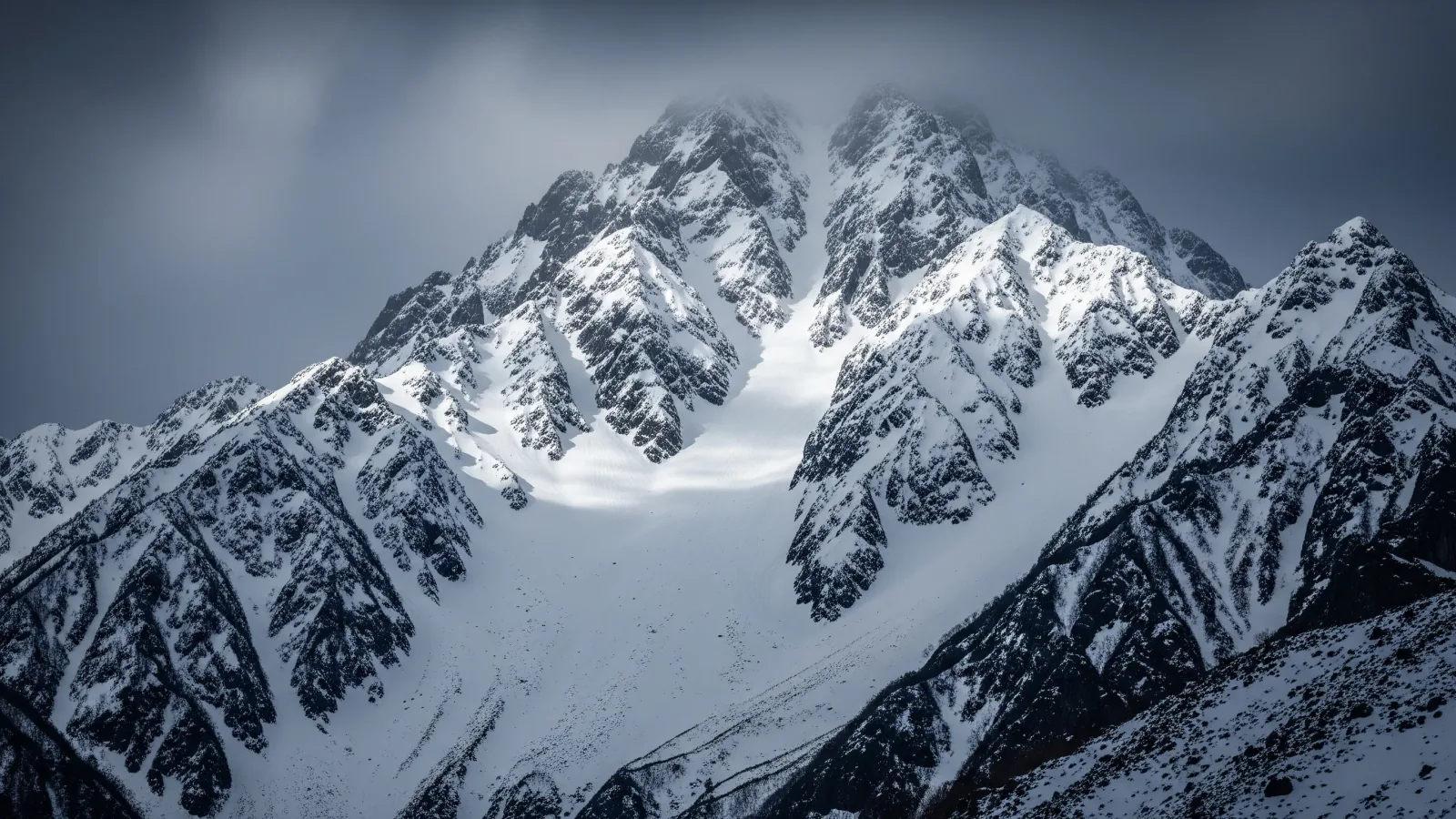
K2, the "Savage Mountain" — more feared than Everest
K2 stands 8,611 m above sea level. Only the second highest mountain on Earth, and yet in the climbing community it is feared far more than Everest. The crown of the Karakoram range, straddling the border between Pakistan and China, has another name: the Savage Mountain.
The name K2 has nothing poetic about it. In 1856, Thomas Montgomerie of the British Great Trigonometrical Survey was sketching the Karakoram from a distance and tagged the second peak he had measured "K2." The other peaks in his notes were later renamed using local Balti names, but K2 sits in a region with no permanent villages and therefore had no indigenous name to inherit. The survey label simply stayed. A peak so remote no one had given it a name — that is K2.
The numbers tell the rest. K2's death rate sits around 23–27 % — roughly one in four people who reach the summit do not come back, or never get there at all. Everest's death rate is about 4 %, which puts K2 in a category nearly seven times more dangerous. As of 2023 only about 800 people in history had stood on K2's summit, compared to more than 10,000 on Everest — a different order of magnitude entirely. No villages within reach, frequent avalanches, brutal summit-day winds, and slopes that drop away on every side — these are what make K2 the most dangerous of the 8,000 m peaks.
A defeated nation's pride — Ardito Desio and the Italian expedition
In 1953, the British succeeded on Everest. That same year, an American expedition attempted K2 and failed. Those two news stories together lit a fire under a single Italian — Ardito Desio, professor at the University of Milan.
Desio already knew the Karakoram from a 1929 scientific survey, and he started lobbying the Italian government to back a K2 expedition. Italy was less than a decade out from defeat in the Second World War and hungry for prestige. A first ascent of the most difficult 8,000 m peak in the world was an irresistible project. Treasury officials initially refused on cost grounds, but public sentiment — the idea that Italy should be the country that bagged K2 for the sake of national honour — overrode them, and the expedition was approved.
An expedition run like an army
With full backing from the Italian Alpine Club (CAI), Desio gathered the strongest climbers from across the country. He ran an unusual tryout selection — two training camps — and ultimately chose 11 climbers. But his style of command cast a long shadow. Behind his back people called him il Ducetto ("the little Mussolini"). He was authoritarian enough to make every team member formally pledge loyalty to him as leader. He commanded from Base Camp and never once set foot on the Abruzzi Ridge himself.
The legendary climber Riccardo Cassin was cut from the team during selection. The official reasons given were varicose veins and a liver problem, but it was widely understood that Desio simply removed anyone whose stature might rival his own authority.
A young prodigy on the team — Walter Bonatti
Among the climbers who did make the cut was 24-year-old Walter Bonatti. The youngest on the team, but already one of Italy's most distinguished climbers — Bonatti was the expedition's hidden ace. His sheer ability, though, would in time draw envy and suspicion.
The Abruzzi Ridge — a fight above 8,000 m
In the summer of 1954, the expedition reached K2's Base Camp via the Baltoro Glacier in northern Pakistan. Their route was the Southeast Spur — better known as the Abruzzi Ridge — first attempted in 1909 by the Italian Duke of the Abruzzi himself. Technically it was the most realistic line to the summit.
K2 punished them at every elevation. Above 6,000 m, blizzards came in without warning, and avalanche danger never let up. One team member, Mario Puchoz, collapsed with pneumonia, and the descent could not be made fast enough — he died. He was the expedition's only fatality, and his death sat heavily on the survivors.
Setting the final camp
By late July the team had reached Camp 8 at around 7,740 m. From there, the chosen summit pair was 40-year-old Achille Compagnoni and 29-year-old Lino Lacedelli. The plan was to set Camp 9 at around 8,050 m and go for the top the next day.
The problem was the oxygen. A summit push needed supplemental oxygen, and the heavy bottles had to be hauled up to the final camp first. That punishing job — exhausting, dangerous, and not the one anyone wanted — was given to Bonatti and a Hunza high-altitude porter, Amir Mahdi.
The Bonatti tragedy — the night of betrayal
On 30 July 1954, fate arrived. Bonatti and Mahdi, each carrying roughly 18 kg of oxygen bottles on their backs, climbed the Abruzzi Ridge into the closing evening light. According to the plan agreed earlier, Compagnoni and Lacedelli were waiting at Camp 9 to receive the bottles.
But as Bonatti got close to where the camp should have been, there was no tent. Compagnoni had moved the camp higher than agreed. In the dimming light, just close enough to hear each other shouting, Compagnoni's pair answered Bonatti's calls — but did not direct him to the tent. Darkness took over completely. Bonatti and Mahdi could neither climb up nor descend.
An open bivouac at 8,100 m
At 8,100 m — without tent or sleeping bag — the two of them had no choice but to spend the night in the open. An open bivouac at that altitude had no precedent in mountaineering at the time. Below −40 °C, oxygen at roughly a third of sea-level pressure. There was no honest reason to expect either of them to come back alive.
Years later, Lacedelli confessed in his own book what had happened: Compagnoni had moved the camp deliberately. The reason was simple. Bonatti was the stronger climber, and Compagnoni did not want to risk the man who outclassed him stealing the summit.
At first light, instructions came down from Compagnoni's pair: leave the bottles where you are and go down. Bonatti dropped the oxygen on the snow and began the descent with his body half frozen. Mahdi was already in severe frostbite and would later have to have nearly every finger and toe amputated.
The summit, and the lie — 31 July 1954
Early on 31 July 1954, Compagnoni and Lacedelli collected the oxygen bottles Bonatti had left and pushed for the top. At 6:10 p.m., the two of them stood on the summit of K2. The first time a human being had set foot on the second highest mountain on Earth.
Italy went wild. A defeated nation had stood on top of the most difficult of the 8,000 m peaks. Compagnoni and Lacedelli came home as national heroes.
An official report built on a lie
Behind the glory, an ugly cover-up was already underway. Desio's official expedition report contained outright fabrications. The report claimed the oxygen bottles had lost pressure and run dry before the summit was reached, and it strongly implied that Bonatti had used the oxygen for himself.
This wasn't merely misleading — it was physically impossible. Bonatti carried no oxygen mask and no mixing valve, so drawing oxygen from the bottles was literally not something he could have done. Worse, photographs from the summit released later clearly showed Compagnoni still wearing his oxygen mask on top — directly contradicting the official claim that the oxygen had run out below the summit.
The motive for the lie was obvious. Compagnoni feared that Bonatti — the stronger climber — would be remembered as the man who really made the summit possible. The expedition's leadership found the idea of a guide-class climber from outside the establishment claiming the spotlight unacceptable.
Fifty years of fighting for the truth
Bonatti contested the official record from the moment it was published. The Italian Alpine Club adopted Desio's report as the official line and dismissed Bonatti's protests. Overturning a national hero story would have meant damaging one of the symbols of post-war Italian recovery.
Out of options, Bonatti went to the courts. He won the defamation suits — but the CAI's official version did not change. He stepped away from competitive climbing and made a living as a journalist, travelling the world. He never stopped trying to clear his name.
Lacedelli breaks the silence
The turning point came in 2004. After fifty years of silence, Lacedelli finally spoke. In his book K2: The Price of Conquest he admitted that Compagnoni had moved the camp deliberately, and that the official account of the oxygen had been a lie. Bonatti, he wrote, had been telling the truth from the start.
In 2007, the CAI accepted the findings of a review panel — known as I Tre Saggi ("The Three Wise Men") — and issued a revised official record of the climb. More than half a century after the expedition, Bonatti's version of events was finally recognised as the true one.
What became of Bonatti and Mahdi
Bonatti remained a great climber after K2. In 1955 he soloed the first ascent of the southwest face of the Petit Dru, one of many landmark climbs that followed. He died in 2011 at the age of 81. His name was, in the end, fully restored — just barely in time.
Mahdi's fate was harsher. With fingers and toes lost to frostbite, he lived out his life in Pakistan in poverty. He had made the climb possible at enormous personal cost, and for decades the official record in Italy barely mentioned him. The pattern — first ascents built on the bodies of high-altitude porters whose names never carry — is a problem the Himalaya is still working through today.
K2 today
On 16 January 2021, a team of ten Nepali climbers made the first winter ascent of K2 — closing the final unclimbed-in-winter chapter on the fourteen 8,000 m peaks. A new page in Himalayan history. And yet K2 still kills several climbers most years. Seventy years on from its first ascent, the Savage Mountain has not softened one bit.